Boro Foundry has introduced a new arrangement that means 100% of its waste foundry sand is now diverted from landfill. The development forms part of a wider programme of practical investment that also includes more efficient ladle heating and upgraded extraction equipment.
Together, these projects are helping Boro reduce waste and energy consumption, improve process control and maintain a safer, more efficient foundry for the future.
Finding a new destination for waste foundry sand
Foundry sand can be reclaimed and reused several times during the casting process, but it eventually reaches the end of its usable life.
Boro purchases approximately 1,250 tonnes of sand each year. Between February 2025 and January 2026, 348 tonnes of Boro’s used sand were sent for use in tarmac production, while a further 485 tonnes went to landfill.
The challenge was to find a suitable alternative destination for the material that could no longer be reused.
In August 2026, Boro began a new arrangement with Booth Ventures Waste Ltd that enables this remaining material to be used in restoration work at Sandown Quarry. As a result, none of Boro’s waste foundry sand now needs to go to landfill.
The new route is also relatively local, with the quarry located in Walsall. Combined with the established use of waste sand in tarmac production, the arrangement provides an ongoing outlet for all of the sand leaving the foundry.
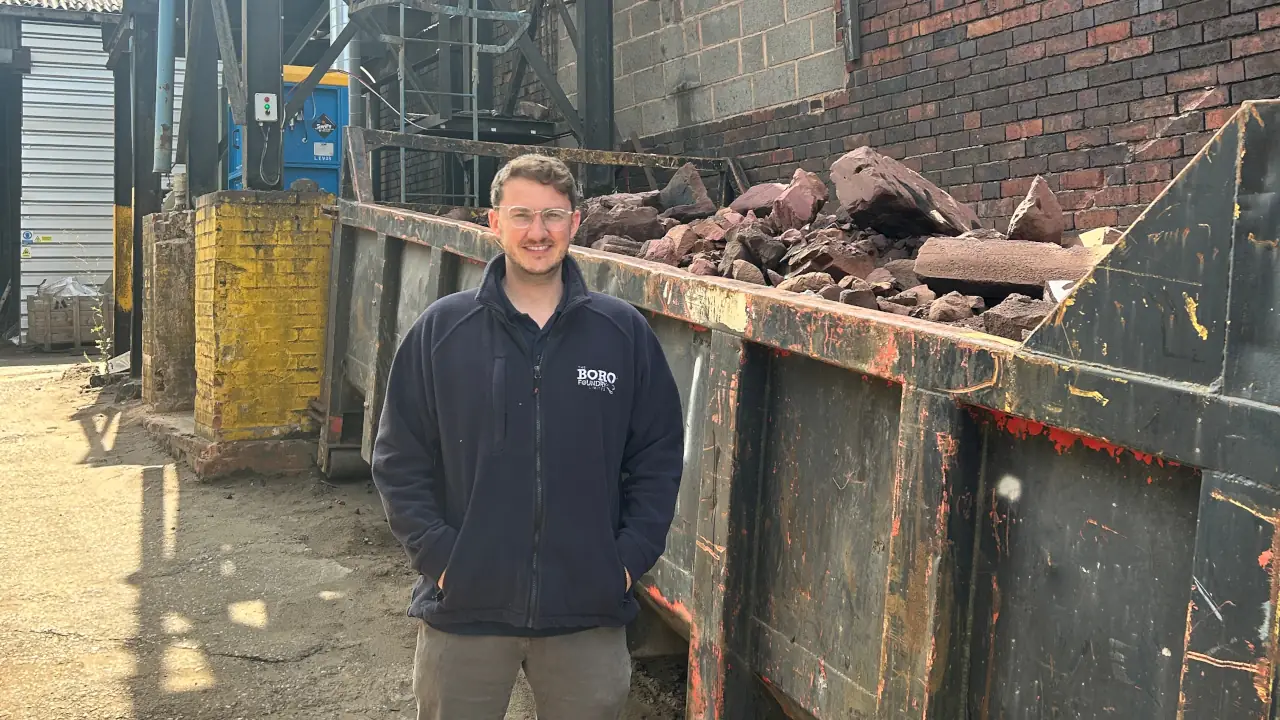
Sam Edwards with 15 tonnes of waste foundry sand ready for restoration work at Sandown Quarry.
Reducing gas use through better ladle heating
Alongside the waste-sand project, Boro has invested in a new ladle-preheating system to replace an older gas burner that offered limited control.
The previous system relied on manually adjusted airflow and would typically be switched on two to three hours before a ladle was required. With no precise temperature control, operators had less certainty over whether the ladle had reached and maintained the correct temperature.
Following a successful six-month trial using a loan unit, Boro’s permanent system became fully operational in June 2026.
The new burner is controlled through a programmable logic controller, or PLC. It can bring a ladle up to the required temperature in approximately 20 minutes, then automatically cut out and restart as needed to maintain that temperature.
Gas-usage measurements taken over nine months showed a reduction of approximately 40%, which Boro expects to maintain with the permanent system.
The improvement is not only about energy consumption. Even a relatively small difference in ladle temperature can affect a casting. Faster, more accurate heating removes much of the uncertainty from the process, helping to maintain more consistent casting conditions and reduce the risk of defects and remakes.
Bringing extraction equipment up to date
Boro has also replaced the local exhaust ventilation system serving its sand hopper.
The previous LEV equipment had become obsolete and was no longer compliant. The replacement system, installed at the end of June 2026, brings the extraction equipment back up to current requirements while also making it easier to maintain.
Although less visible than some production investments, reliable extraction is an important part of maintaining an effective and responsible foundry environment.
Practical improvements with long-term value
These three projects address different areas of the operation, but each reflects the same approach: identifying where waste, energy use or ageing equipment can be reduced and investing in practical improvements.
- 100% of Boro’s waste foundry sand is now diverted from landfill.
- Measured gas consumption for ladle preheating has reduced by approximately 40%.
- Ladle-heating time has fallen from two to three hours to around 20 minutes.
- PLC-based temperature control provides greater consistency and removes much of the guesswork from the heating process.
- The upgraded LEV system is compliant and easier to maintain.
“Reducing energy consumption and waste isn’t just the right thing to do; it is fundamental to the future of British manufacturing. By operating more efficiently, we reduce costs, improve sustainability and strengthen Boro Foundry’s ability to compete in an ever-changing global market.”
Sam Edwards, Sales Director at Boro Foundry
Investing in the next generation
As a fourth-generation family business, Boro views these improvements as part of its responsibility to its employees, its community and the environment, as well as to its customers.
Continued investment in cleaner, smarter and more efficient ways of working will help the company remain competitive while maintaining the quality and reliability expected of a UK manufacturing partner.
“These projects are about more than compliance or cost savings. They reflect the values of a fourth-generation family business that believes in taking responsibility for its impact.
“We want customers to know that we are committed to investing in the future, not only through the quality of the castings we produce, but through the way we operate as a business. Responsible manufacturing, continuous improvement and long-term thinking are central to who we are.”
Sam Edwards, Sales Director at Boro Foundry
Reducing Waste. Improving Control.
Responsible manufacturing is built on continuous improvement. By reducing waste, using energy more efficiently and investing in greater process control, Boro Foundry is strengthening the consistency and resilience of its operations.
Get in touch with Boro Foundry to discuss your next casting project and discover how our commitment to quality, efficient production and long-term investment can support your requirements.