Project Overview
Boro Foundry was engaged to support the redevelopment of a Power Lift Arm used on Unimog vehicles, supplied by Atkinson Vos Ltd, a specialist provider of aftermarket Unimog components.
The existing Power Lift Arm was a complex multi-part fabricated steel assembly, made up of multiple laser-cut plates and welded reinforcements. While functional, the design had developed persistent issues in service — including torsional failures under eccentric loading and binding within the telescopic lift mechanism — leading to reliability concerns and increased field failures.
Atkinson Vos approached Boro Foundry to explore whether a cast alternative could overcome these limitations. The brief was not simply to replicate the existing part in cast form, but to re-engineer the component to improve strength, reliability, and performance — while maintaining comparable weight and production cost.
The resulting project became a collaborative engineering exercise, combining casting expertise, material selection, and design optimisation, ultimately replacing an 11-piece steel fabrication with a single-piece Austempered Ductile Iron (ADI) casting.
The finished component delivered improved structural performance, resolved long-standing operational issues, and went on to receive Casting Component of the Year (2022) recognition.


The Challenge: Why the Original Fabrication Failed
The original Power Lift Arm supplied by Atkinson Vos Ltd was manufactured as a fabricated steel assembly, constructed from multiple laser-cut S355 steel plates welded together. Over time, the design evolved to include additional reinforcement plates in response to failures experienced in service.
Despite these modifications, the fabricated approach continued to present two fundamental problems.
Firstly, the component was prone to torsional failure under eccentric loading. The complex, multi-piece construction created stress concentrations around welded joints, particularly when the arm was subjected to uneven loads during lifting operations. While adding further steel plates increased stiffness locally, it also added weight and complexity without addressing the underlying load-path inefficiencies inherent in the fabricated design.
Secondly, the geometry limitations imposed by fabrication led to operational issues within the telescopic lift mechanism. The lift rods were set at a slight angle due to the constraints of the welded assembly, which caused binding during operation. Over time, this binding resulted in increased wear, reduced reliability, and in some cases bending of the telescopic components — an unacceptable outcome for a safety-critical lifting application operating in demanding environments.
Attempts to strengthen the fabricated arm only compounded the issue. Each additional plate or weld increased part count, manufacturing time, and visual complexity, while still failing to deliver a robust, long-term solution. It became clear that the limitations were not purely material-related, but fundamental to the fabrication method itself.
To achieve a meaningful improvement in performance, Atkinson Vos required a solution that allowed the geometry of the component to be reconsidered entirely — something that fabrication could no longer offer. This challenge set the foundation for exploring a cast alternative with Boro Foundry, where both form and material could be optimised together rather than compromised by process constraints.

Why Casting — and Why ADI
With the limitations of fabrication clearly defined, the focus shifted to identifying a manufacturing approach that would allow the Power Lift Arm to be re-engineered from first principles, rather than incrementally reinforced. Casting presented a clear opportunity to address both the structural and geometric constraints inherent in the original design.
Working with Boro Foundry, the project team explored how a cast solution could consolidate the multi-part assembly into a single, integrated component. Casting offered the freedom to redesign load paths, remove welded joints, and introduce smoother transitions throughout the part — all critical factors in improving performance under complex loading conditions.
Material selection was central to this approach. Rather than defaulting to cast steel, the decision was made to pursue Austempered Ductile Iron (ADI), specifically grade ADI 900-8. ADI provides mechanical properties comparable to high-strength steels, while offering lower density and improved fatigue performance — making it particularly well suited to structurally demanding components where weight and durability must be carefully balanced.
Crucially, ADI also enabled further optimisation of the component geometry. The increased strength of the material allowed section sizes to be reduced where appropriate, while still meeting performance requirements. This flexibility made it possible to redesign the arm so that the telescopic lift rods could be brought into proper alignment, eliminating the binding issues that had persisted in the fabricated version.
For Boro Foundry, the move to an ADI casting was not simply a material substitution, but a manufacturing-led engineering solution. By combining material capability with casting-driven design freedom, the project could move beyond the constraints of fabrication and toward a fundamentally more robust and efficient component.


Design Development & Engineering Collaboration
The transition from fabrication to casting allowed the Power Lift Arm to be reconsidered as a single, integrated structure, rather than an assembly of individual plates. With Boro Foundry involved at an early stage, the design process focused on achieving the required strength and functionality while ensuring the component could be manufactured reliably as a casting.
Early design concepts explored direct cast replacements for the fabricated arm, including cast steel and initial ADI geometries. While these early iterations demonstrated the potential for weight reduction and part consolidation, they also highlighted that material change alone was not sufficient. In particular, some early cast designs still retained angled arm geometry, meaning the binding issues within the telescopic lift mechanism were not fully resolved.
To address this, the project progressed into a more detailed design phase in collaboration with Lancaster University, where multiple redesigns were evaluated with both performance and manufacturability in mind. This phase focused on:
- Reconfiguring the arm geometry to bring the telescopic lift rods into proper alignment
- Optimising load paths to reduce torsional stress under eccentric loading
- Balancing section thickness and overall mass to maintain a competitive weight
The flexibility offered by casting — and particularly by ADI — allowed these geometric changes to be implemented without introducing the complexity or compromises associated with fabrication. Boro Foundry’s input during this stage ensured that the evolving designs remained practical to produce, with attention paid to moulding strategy, section transitions, and dimensional stability.
The final design represented a clear departure from the original fabricated concept: a one-piece ADI casting engineered specifically to eliminate binding, reduce stress concentrations, and deliver consistent performance in service. This design-led approach laid the foundation for subsequent validation and production, demonstrating the value of integrating manufacturing expertise directly into the engineering process.


Simulation & Performance Validation
With the final ADI casting geometry established, detailed simulation work was carried out to validate the design and directly compare its performance against the original fabricated steel arm. This analysis focused on the same extreme loading conditions that had previously caused failures in service, ensuring a like-for-like assessment of structural behaviour.
Finite Element Analysis (FEA) was used to evaluate both designs under eccentric loading scenarios. The original fabricated arm showed multiple areas of elevated stress, particularly around welded joints and reinforcement plates, with several regions exhibiting low factors of safety. These stress concentrations aligned closely with the failure modes observed in real-world operation.
In contrast, the ADI cast design demonstrated a significantly improved stress distribution across the entire component. The smoother geometry and optimised load paths achievable through casting reduced peak stresses and eliminated the localised hot spots present in the fabricated assembly. As a result, the cast arm achieved a consistently higher factor of safety, even under demanding load cases.
This work was carried out in collaboration with Lancaster University, providing independent validation of the design approach and reinforcing confidence in the final solution. The analysis confirmed that the move to a single-piece ADI casting did more than simplify manufacture — it delivered a measurable and meaningful improvement in structural performance.
For Boro Foundry, this validation stage was critical. It ensured that the proposed casting solution was not only manufacturable, but demonstrably superior to the fabricated design it replaced, providing both the customer and end users with confidence in long-term reliability and safety.


Manufacturing the ADI Casting
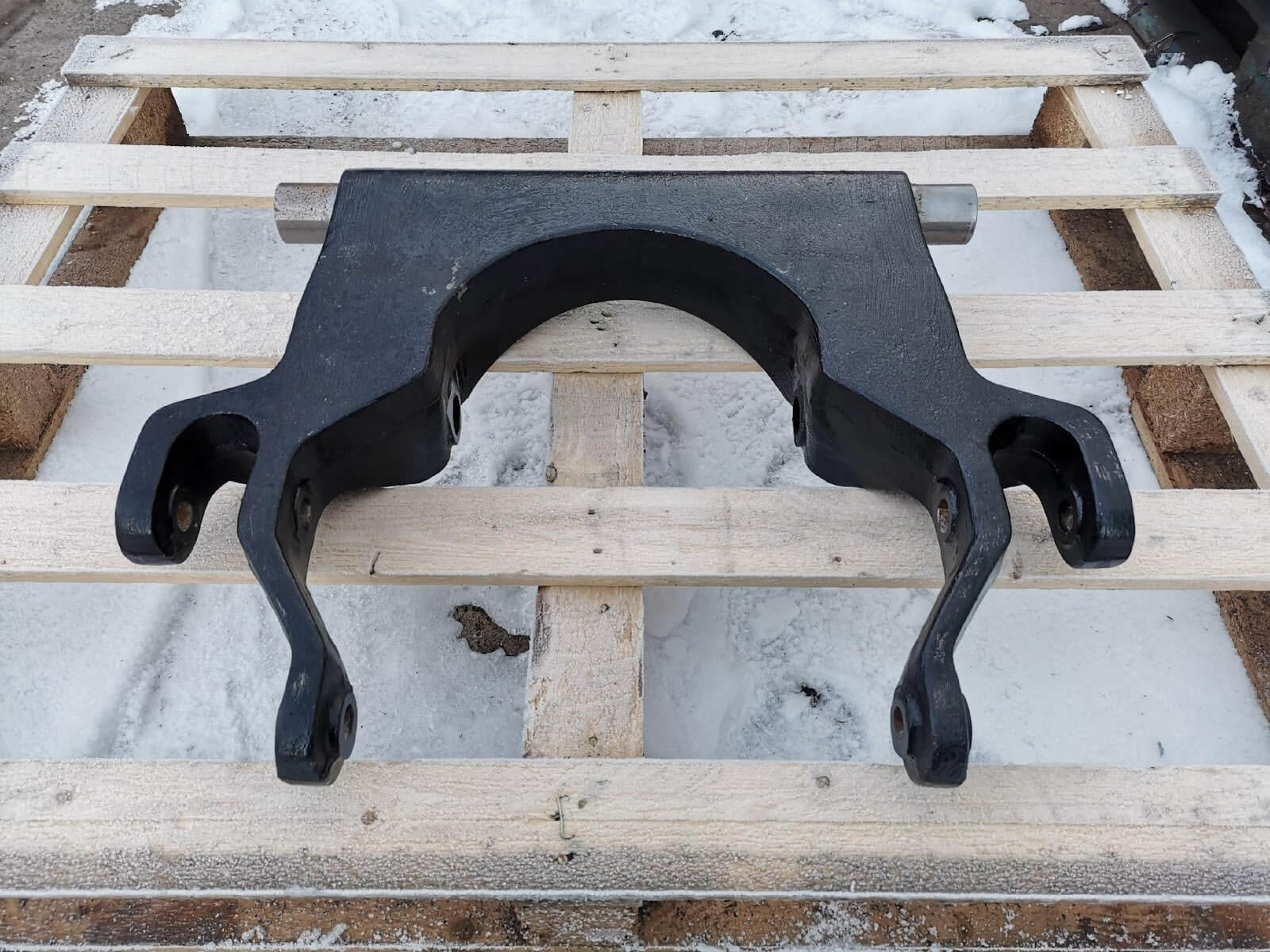
Once the final design had been validated, Boro Foundry led the transition from engineered concept to repeatable production. The Power Lift Arm was manufactured as a single-piece casting, consolidating the original multi-part fabrication into one structurally continuous component.
The casting was produced using a floor-moulded alkaline phenolic sand system, selected to accommodate the component’s size, geometry, and section thickness while maintaining dimensional accuracy. The final casting envelope measured approximately 660 mm wide, 520 mm long, and 120 mm high, with a maximum section thickness of 80 mm — a critical consideration for subsequent heat treatment.
To support efficient and consistent moulding, Boro Foundry employed a loose pattern with an odd side, helping to minimise moulding time while maintaining control over key features. No cores were required, simplifying the moulding process and reducing the risk of internal defects. The final poured weight was approximately 88 kg, achieving a yield of around 70%.
A temporary tie bar was incorporated into the casting design to stabilise the arms during heat treatment. This ensured dimensional stability through the austempering process and was later removed during machining.
Throughout production, Boro Foundry’s focus was on delivering a casting that met both structural performance requirements and downstream processing needs. Close attention was paid to section transitions, surface quality, and dimensional consistency to ensure the casting could be reliably heat treated, machined, and assembled without compromise.
This stage of the project highlighted Boro Foundry’s ability to manufacture large, structurally critical ADI castings, where material performance, geometry, and process control must all work together to deliver a successful outcome.

Heat Treatment, Machining & Assembly
Following casting, the Power Lift Arm underwent austempering to achieve the required mechanical properties for demanding lifting applications. Heat treatment was carried out by ADI Treatments Ltd, using a controlled Universal Batch Quench Austemper (UBQA) process designed to through-harden sections up to 80 mm thick.
To ensure the Power Lift Arm achieved the required mechanical performance across its full section thickness, the ADI chemistry and heat treatment parameters were carefully specified and validated. The melt composition was designed to support through-austempering of sections up to 80 mm, with mechanical testing carried out to confirm compliance with EN 1564 ADI 900-8 requirements prior to final machining and assembly.
Chemical Composition
| Melt | C | Si | Mn | Cu | Ni |
|---|---|---|---|---|---|
| 1 | 3.58 | 2.31 | 0.36 | 0.76 | 1.89 |
| 2 | 3.58 | 2.21 | 0.31 | 0.75 | 1.99 |
Mechanical Properties
| Melt | Tensile Strength (MPa) | Yield Strength (MPa) | Elongation (%) | Brinell Hardness |
|---|---|---|---|---|
| 1 | 1000 | 732 | 10 | 333 |
| 2 | 970 | 674 | 8 | 333 |
| EN1564 Standard | 900 | 600 | 8 | 280 - 340 |
To maintain dimensional stability during austempering, the cast-in tie bar introduced during manufacture played a critical role, preventing movement of the arms while the component was suspended throughout the heat treatment cycle. This approach ensured consistent results and avoided distortion in a component with a complex, load-bearing geometry.
Once austempered, the casting was machined to final specification. Post-heat-treatment machining was required to remove the temporary tie bar and to finish critical features, including two precision bores with H7 tolerance to accommodate steel inserts. These inserts, manufactured from high-strength EN24T steel, were machined separately and press-fitted into the Power Lift Arm to provide durable bearing surfaces in service.
All other machining operations were completed with relatively open tolerances, reflecting the dimensional accuracy achieved during casting and heat treatment. The completed components were supplied ready for final assembly, allowing Atkinson Vos to integrate the Power Lift Arm directly into their Unimog linkage systems.
By managing the interaction between casting, heat treatment, and machining, Boro Foundry ensured the final component met performance, dimensional, and assembly requirements — delivering a fully engineered solution rather than a standalone casting.
Results & Outcomes
The transition from a fabricated steel assembly to a single-piece ADI casting delivered clear technical and commercial benefits. The final Power Lift Arm replaced an 11-piece welded fabrication with a one-piece cast component, significantly reducing part complexity while improving overall structural integrity.
Despite the increased geometric sophistication of the cast design, the finished ADI component achieved a comparable weight to the original fabrication, at approximately 54 kg. Production costs were also maintained at a similar level, even when accounting for pattern manufacture and tooling — demonstrating that the improved performance was achieved without a cost penalty.
From a performance perspective, the benefits were substantial. The redesigned geometry and material selection eliminated the binding issues previously experienced in the telescopic lift mechanism and significantly reduced stress concentrations under eccentric loading. These improvements translated directly into enhanced reliability, reduced risk of in-service failure, and improved confidence in demanding operating conditions.
The move to casting also delivered manufacturing and supply advantages. Consolidating the component into a single casting reduced fabrication time and simplified production, leading to shorter and more predictable lead times for repeat batches.
The success of the project was recognised externally when the Power Lift Arm conversion was awarded Casting Component of the Year in 2022, underlining the effectiveness of the design-led, manufacturing-focused approach taken by Boro Foundry and its project partners.


Industry Recognition
The success of the Power Lift Arm redevelopment was formally recognised when the project received Casting Component of the Year (2022). The award acknowledged not only the technical performance of the finished component, but also the effectiveness of the design-led approach taken to replace a complex fabricated assembly with a single, high-performance casting.
The judging panel highlighted the project’s ability to demonstrate clear advantages of casting over fabrication, including improved structural performance, reduced complexity, and consistent manufacturing outcomes — all achieved without increasing component weight or production cost.
For Boro Foundry, the award reinforced its reputation for delivering engineering-led casting solutions where material selection, geometry, and process control are combined to solve real-world performance challenges. It also provided independent validation of the collaborative approach taken with Atkinson Vos Ltd and project partners to deliver a superior component for demanding applications.