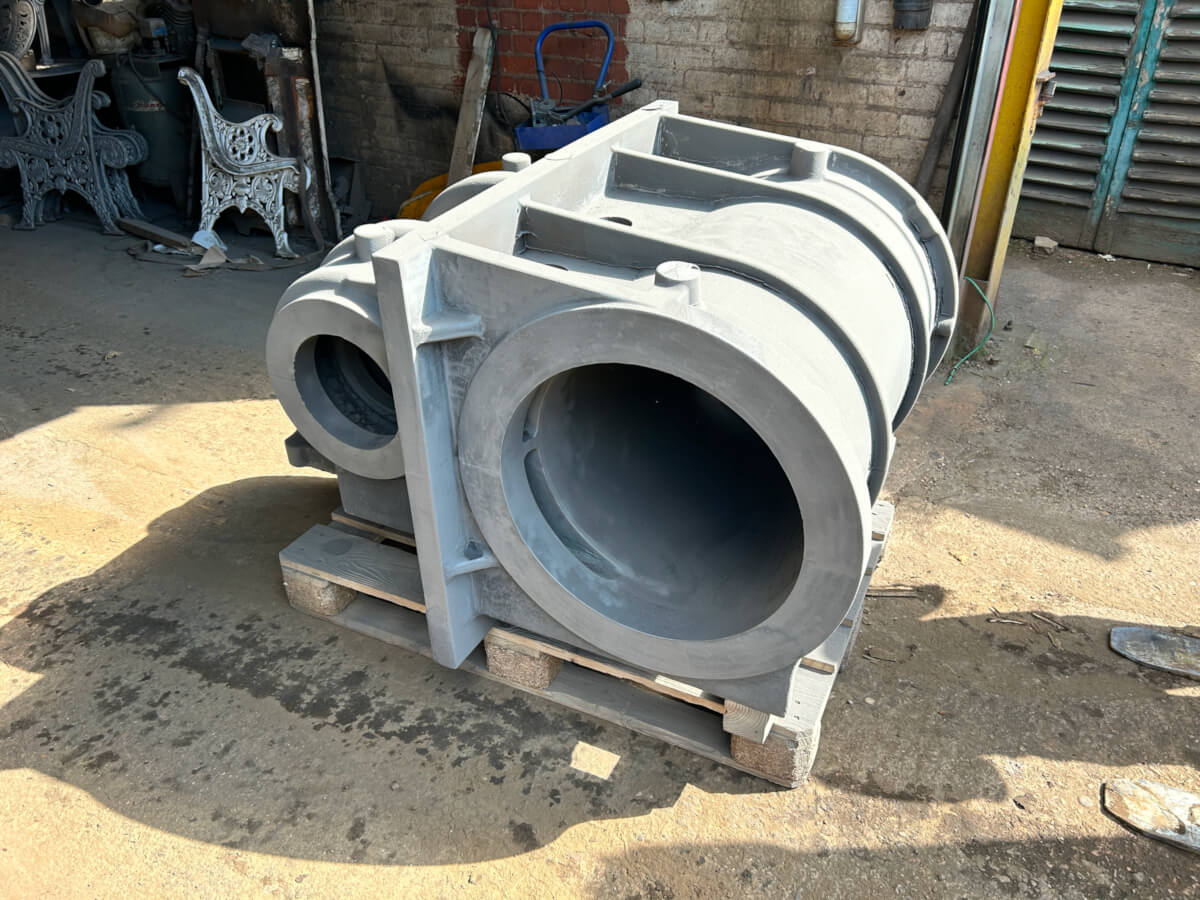
The engineering challenge: Casting a heritage locomotive cylinder
Steam locomotive cylinders are among the most demanding components found in heritage railway engineering. Unlike many modern industrial castings, they combine large physical size, complex internal geometry, and critical functional requirements, all within a low-volume or one-off manufacturing context.
In this project, the requirement was to produce a replacement locomotive cylinder casting suitable for use in a working steam locomotive. The component needed to replicate historically proven geometry while meeting modern expectations around dimensional accuracy, structural integrity, and operational reliability.
From a foundry perspective, locomotive cylinder castings present several inherent challenges:
- Multiple intersecting internal passages for steam admission and exhaust
- Large, enclosed core structures that must remain dimensionally stable during mould assembly and pouring
- Tight alignment requirements between cylinder bores, ports, and mounting faces
- The need for consistent wall thickness to avoid localised stress or thermal imbalance during operation
Compounding this complexity was the fact that the component was not part of a repeat production run. Traditional patternmaking and core box manufacture would have required a significant investment of time and cost for tooling that may only ever be used once.
This combination of geometric complexity, heritage accuracy, and low-volume production made the cylinder an ideal candidate for an alternative manufacturing approach — one that could reduce tooling overhead without compromising the quality or integrity of the final casting.


Technical constraints and casting requirements
Beyond its external size, the true complexity of a locomotive cylinder lies inside the casting. Internally, the component incorporates a network of steam passages, ports, and cavities that must be formed accurately and remain fully enclosed once the casting is complete.
From a technical standpoint, the key constraints included:
Internal geometry and core complexity
The internal passages could not be simplified without affecting performance. This required:
- Highly complex core assemblies
- Precise positioning and registration of internal features
- Confidence that cores would not shift, distort, or collapse during mould handling or metal pouring
In conventional sand casting, this level of complexity often demands multi-part core boxes and intricate core assembly processes, increasing both risk and lead time.
Dimensional accuracy and alignment
The cylinder casting needed to maintain accurate relationships between:
- Cylinder bores
- Steam ports
- Mounting and mating faces
Any deviation could result in inefficient steam flow, mechanical wear, or costly post-casting correction. Achieving this accuracy is particularly challenging when dealing with large sand moulds and long internal cores.
Structural and operational demands
As a working component within a steam locomotive, the cylinder casting is subjected to repeated thermal cycling, high internal steam pressures, and significant mechanical loading during operation. These service conditions place demanding requirements on both the material and the integrity of the casting.
For this project, the cylinder was produced in EN-GJL-250 grey cast iron, with a tailored specification selected to deliver the necessary balance of strength, wear resistance, and thermal stability. The material choice was critical in ensuring the cylinder could withstand operational stresses while maintaining dimensional stability over its service life.
These requirements placed clear constraints on wall thickness consistency, internal surface quality, and overall casting soundness — all of which needed to be addressed at the mould design and manufacturing stage, rather than relying on corrective measures after casting.
Low-volume production constraints
Unlike serial production components, this project offered little opportunity to amortise tooling costs across multiple castings. Any traditional patternmaking route would have involved:
- Long lead times for pattern and core box manufacture
- Increased upfront cost
- Limited flexibility to modify geometry once tooling was produced
For heritage restoration and specialist engineering projects, these factors can become a barrier to feasibility.
Why this matters from a foundry perspective
Taken together, these constraints demanded a manufacturing approach that could deliver:
- High geometric freedom
- Reliable dimensional accuracy
- Reduced tooling dependency
- Confidence in mould and core integrity for a large, high-value casting
This set the foundation for a digitally driven mould and core manufacturing strategy — one that complemented traditional foundry expertise rather than replacing it.
Design and manufacturing approach
Given the geometric complexity of the locomotive cylinder and the practical constraints associated with low-volume production, a digitally driven approach to mould and core manufacture was adopted. Rather than relying on conventional patterns and core boxes, the moulds and cores were produced directly from digital design data.
This approach allowed the full cylinder geometry, including complex internal passages, to be defined and validated at the digital design stage before any physical manufacturing took place. By working directly from CAD data, it was possible to integrate mould and core design into a single, coherent workflow.
Digital mould and core design
The cylinder was designed as a complete digital model, incorporating both external features and internal passages. From this model, the mould and core geometries were generated directly, allowing internal cavities to be formed without the need for separate core box tooling.
This design-led process enabled:
- The accurate reproduction of complex internal steam passages
- Precise control over the spatial relationship between internal and external features
- Early identification and resolution of potential manufacturability issues
By resolving these considerations digitally, the risk associated with physical trial tooling and iterative pattern modification was significantly reduced.
3D sand printing of moulds and cores
Once finalised, the digital mould and core designs were manufactured using a 3D sand printing process. This additive manufacturing method builds sand moulds layer by layer using a binder, allowing highly complex geometries to be produced without the geometric constraints associated with traditional tooling.
For a component of this size and complexity, 3D sand printing offered several practical advantages:
- The ability to produce large mould sections and complex cores directly from digital files
- Elimination of conventional patternmaking and core box manufacture
- Reduced lead time compared to traditional tooling routes
- Greater design freedom for enclosed internal geometries
The printed sand moulds and cores were produced as ready-to-use components, requiring minimal manual assembly compared to traditional multi-part core systems.
Integration with foundry processes
Although the moulds and cores were produced using additive manufacturing, the subsequent stages of the process followed established foundry practice. The printed sand components were handled, assembled, and prepared for casting using standard foundry methods.
This integration ensured that digital manufacturing techniques complemented existing foundry expertise rather than replacing it. Control over mould assembly, pouring procedures, and quality considerations remained central to the process.
By combining digital mould production with traditional foundry knowledge, it was possible to manage the risks associated with producing a large, high-value casting while taking advantage of the flexibility offered by additive manufacturing.


Foundry execution and casting considerations
While additive manufacturing played a key role in producing the moulds and cores, the success of the project ultimately depended on careful foundry execution. Producing a large, complex, one-off casting requires close control of every stage of the casting process, from mould handling through to pouring and solidification.
Mould and core handling
The size and complexity of the printed sand moulds and cores required careful handling during transport, assembly, and preparation for casting. Maintaining dimensional stability throughout these stages was essential to ensure that the internal and external features of the cylinder remained correctly aligned.
Compared to conventional multi-part core assemblies, the printed cores reduced the number of individual components that needed to be assembled. This simplified handling and reduced the potential for misalignment during mould assembly.
Assembly and preparation for casting
During mould assembly, particular attention was paid to the accurate positioning of cores and the integrity of joints between mould sections. Ensuring a secure and stable assembly was critical, given the enclosed nature of the internal passages and the overall mass of the mould.
Standard foundry practices were applied to prepare the mould for casting, including inspection of critical features and verification that all internal cavities were correctly formed and supported prior to pouring.
Pouring considerations
The pouring of a large locomotive cylinder casting presents inherent challenges, particularly in managing metal flow into complex internal geometries. Pouring parameters needed to be controlled to ensure complete filling of the mould while minimising the risk of defects associated with turbulence or incomplete feed.
As with any high-value, one-off casting, the pouring process was approached with a focus on consistency and control, drawing on established foundry knowledge to manage risk during this critical stage.
Quality control and inspection
Given the complexity and importance of the component, quality control formed an integral part of the manufacturing process. Inspection focused on verifying that the casting geometry corresponded to the intended design and that internal features had been accurately reproduced.
Any issues identified during inspection could be assessed in the context of the digital design data, allowing a clear comparison between the intended geometry and the finished casting.
This combination of digital design reference and traditional inspection methods helped provide confidence in the integrity of the final component.


Results and outcomes
The completed casting demonstrated that complex locomotive cylinder geometry can be successfully produced using a digitally driven mould and core manufacturing approach. The combination of digital design, 3D sand printing, and established foundry practice enabled the cylinder to be manufactured without the need for conventional patterns or core boxes.
Internal passages and external features were formed as part of a single, integrated casting, reflecting the intended design geometry. The use of printed sand moulds and cores allowed complex internal features to be produced without the assembly complexity typically associated with traditional core systems.
From a production perspective, the approach reduced the time and effort associated with tooling manufacture. By working directly from digital design data, the project avoided the extended lead times normally required to produce patterns and core boxes for a one-off component of this type.
The project also demonstrated the suitability of additive manufacturing techniques for heritage and specialist engineering applications, where components are often produced in very low volumes and traditional tooling costs can be difficult to justify.
Overall, the outcome showed that additive manufacturing can be effectively integrated into foundry workflows to support the production of large, complex castings, while maintaining control over quality and manufacturing risk.


Broader implications for foundry manufacturing
This project highlights how additive manufacturing techniques, such as 3D sand printing, can be applied effectively within a foundry environment when used in conjunction with established casting knowledge. Rather than replacing traditional foundry processes, digital mould and core production can be used to address specific manufacturing challenges associated with complex geometry and low-volume production.
For heritage engineering and specialist applications, where components are often produced as one-off or limited-run castings, the ability to manufacture moulds and cores directly from digital data offers a practical alternative to conventional tooling routes. This approach can help reduce lead times and tooling effort while retaining control over critical casting parameters.
The locomotive cylinder casting demonstrates that complex internal geometries, traditionally associated with high tooling complexity and risk, can be managed through a digitally driven design and manufacturing workflow. When supported by careful foundry execution, this enables the production of large, high-value castings with a high degree of geometric fidelity.
More broadly, the project illustrates how additive manufacturing can form part of a flexible manufacturing strategy for foundries, supporting projects that fall outside the scope of conventional series production while maintaining the principles of quality, control, and engineering integrity.