Project Overview
A national contractor specialising in heritage refurbishment approached Boro Foundry as part of a major restoration project for a well-known English museum. Many of the museum’s original cast iron floor grilles had become worn, cracked, or structurally compromised. Because the building holds heritage status, every replacement grille had to be produced like-for-like, preserving both the aesthetics and the integrity of the original designs. The contractor required a reliable foundry partner capable of reverse-engineering the historic components and delivering high-quality castings under tight project deadlines.
Component Details
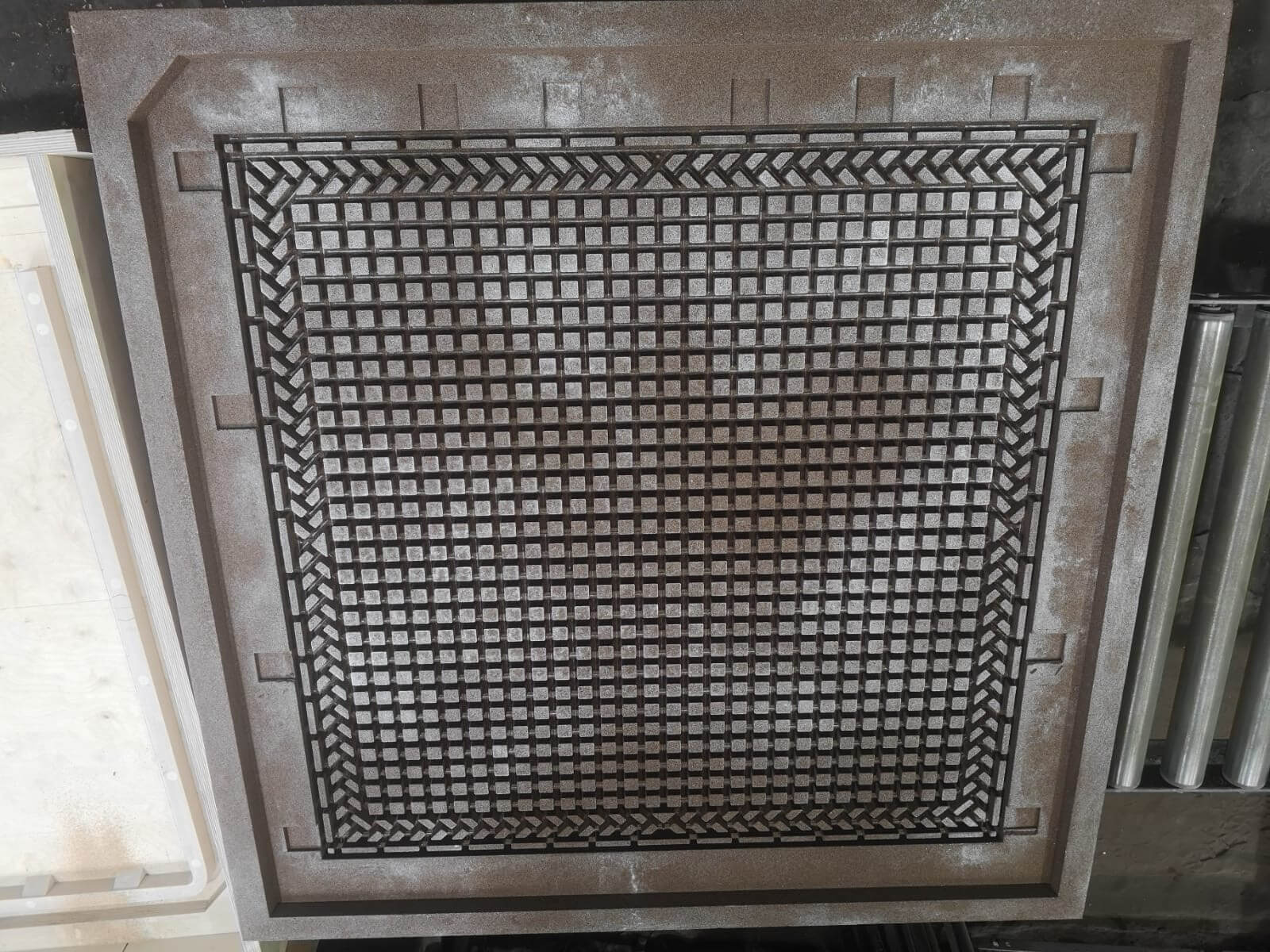
The components were large decorative cast iron floor grilles measuring approximately 1200 × 1200 × 20 mm and weighing around 68 kg each. The grilles form part of the public walkway within the museum, meaning strength, durability, and dimensional accuracy were essential. Although the overall geometry appears simple at first glance, the internal grid structure is delicate and requires precise casting control to avoid breakage or defects.
Material & Specification
The grilles were cast in EN-GJL-250 grey cast iron, with a tailored chemical composition developed to suit the demands of the component. Due to the intricate lattice geometry, the specification was optimised to improve metal fluidity during pouring, ensuring complete fill of the fine sections without compromising structural integrity.
This approach allowed the castings to retain the strength and durability required for a high-traffic public environment, while faithfully reproducing the original historic designs.
Manufacturing Process
The components were produced using air-set sand moulding on Boro Foundry’s semi-automated line. The rollover moulding system played a crucial role in achieving a precise strip of sand from the pattern; this was vital for maintaining the delicate grille openings without damaging the mould.
No cores were required — the job was executed using a carefully assembled cope and drag arrangement. As no drawings existed for the original parts, Boro reverse-engineered the grilles directly from supplied samples. The resulting patterns were CNC-machined for accuracy and efficiency, reducing downstream processing.
Engineering & Design Input
Boro’s engineering team developed a bespoke running system designed to ensure fast, even metal flow throughout the cavity. The gating layout was intentionally positioned around the outer perimeter to avoid affecting the visible surfaces and to preserve the grille’s original aesthetic.
Full casting simulation was carried out prior to production, validating the fill, predicting potential problem zones, and confirming that the component could be produced to the required standard without internal defects. Sampling runs were completed to verify the methodology before final production.
Challenges & Solutions
The project presented two main challenges: the complexity of the grille’s geometry and the tight deadline imposed by the wider refurbishment schedule.
Boro addressed this through:
- detailed simulation work to optimise metal flow
- a high-integrity running system designed for rapid filling
- careful mould handling using the foundry’s mould manipulators
- pattern accuracy achieved through CNC machining
These measures reduced the risk of casting defects and kept fettling requirements to a minimum, saving time without compromising quality.



Outcome
Boro Foundry delivered the replacement grilles on schedule, enabling the contractor to complete the installation without delay. The finished castings matched the originals in both appearance and function, preserving the museum’s heritage character while providing the structural reliability required for public use.
Although this was a one-off project, the successful delivery has opened the door to similar opportunities within the heritage sector.
Additional Notes
This project involved the largest and heaviest floor grille Boro Foundry has produced to date. The lessons learned — particularly around handling intricate, large-format air-set moulds with minimal fettling — have strengthened Boro’s capability for future bespoke and heritage-focused casting projects.